
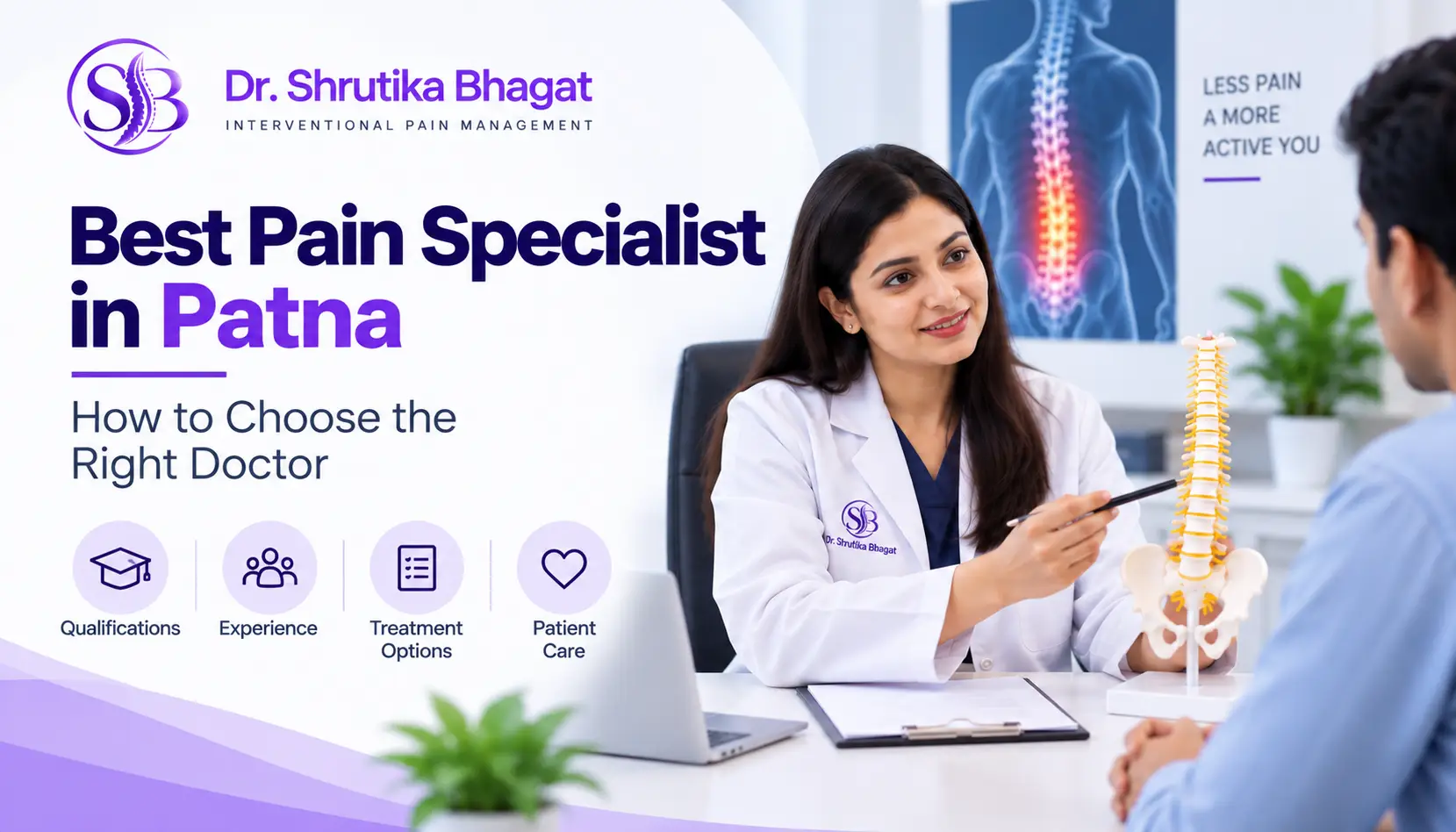
Choosing the right pain specialist in Patna can make an important difference in understanding the cause of persistent pain and selecting an appropriate treatment plan. Instead of choosing a doctor only because of online ratings or the word “best,” patients should consider medical qualifications, pain-medicine training, clinical experience, diagnostic approach, available treatments and the quality of communication.
Dr. Shrutika Bhagat is an Interventional Pain Physician and Spine Endoscopy Specialist in Patna with MBBS, MD, FIRA and FIAPM qualifications. Her clinical focus includes evidence-based, image-guided pain care and minimally invasive spine procedures for selected spine, nerve and chronic pain conditions.
If you are exploring treatment options, you can learn more about Dr. Shrutika Bhagat's qualifications and clinical approach before scheduling a consultation.
What Is a Pain Specialist?
A pain specialist is a doctor trained to evaluate and manage different types of acute and chronic pain. The first step is usually to understand the patient's symptoms, medical history, physical examination findings and, when appropriate, imaging or other diagnostic information.
Pain can originate from different structures, including muscles, joints, nerves, discs or other parts of the musculoskeletal system. Because the cause of pain varies from person to person, treatment should be based on an individual clinical assessment rather than a one-size-fits-all approach.
According to the Indian Society for Study of Pain (ISSP), pain medicine is a specialized field focused on the assessment and management of pain. Patients can use professional medical organizations as one source of information when learning about pain medicine and specialist care.
How to Choose the Right Pain Specialist in Patna
When searching for a pain specialist, consider several factors rather than relying on a single review, advertisement or treatment claim.
1. Check Medical Qualifications
Start by checking the doctor's basic medical qualifications and additional training relevant to pain medicine. For patients considering interventional treatment, fellowship or specialized training in pain management can also be an important consideration.
Dr. Shrutika Bhagat's published credentials include MBBS, MD, FIRA from Ganga Hospital and FIAPM, along with specialized training in endoscopic spine procedures. Her clinical profile focuses on interventional pain medicine and spine endoscopy.
2. Consider Experience With Your Type of Pain
Pain is not a single condition. A patient with lower back pain may have a different underlying problem from someone experiencing sciatica, neck pain, facial nerve pain or joint-related pain.
Look for a doctor who regularly evaluates conditions similar to yours. This can help ensure that your consultation is focused on identifying the likely source of pain and discussing appropriate treatment choices.
You can explore the different pain and spine conditions evaluated at Dr. Shrutika Bhagat's clinic to understand whether your symptoms fall within her clinical focus.
3. Look for a Proper Diagnostic Approach
A good pain consultation should begin with diagnosis rather than immediately recommending a procedure. Your doctor should discuss your symptoms, examine the affected area and review relevant medical records or imaging when necessary.
MRI or other imaging findings should also be interpreted alongside the clinical examination. An abnormal scan does not always mean that the abnormality is the actual source of pain.
4. Ask About Non-Surgical Treatment Options
Not every patient with back pain, neck pain or nerve pain requires surgery. Depending on the diagnosis, treatment may include medicines, physical rehabilitation, lifestyle modification, targeted injections or other interventional procedures.
The goal should be to select the least invasive treatment that is appropriate for the individual's condition while considering expected benefits, limitations and potential risks.
5. Understand Image-Guided Procedures
Some interventional pain procedures are performed using imaging guidance such as fluoroscopy or ultrasound. Image guidance can help the physician accurately target the intended anatomical structure.
Before undergoing a procedure, ask why it has been recommended, what problem it is intended to address, what alternatives are available and what risks or side effects should be considered.
6. Review the Doctor's Treatment Expertise
A pain specialist may offer different treatment approaches depending on the underlying diagnosis. These can include targeted injections, radiofrequency procedures, nerve blocks, neuromodulation and selected minimally invasive spine procedures.
Dr. Shrutika Bhagat's website lists several interventional pain and spine treatments, including spine endoscopy, epidural steroid injections, radiofrequency ablation, nerve procedures and regenerative treatments.
Common Conditions Managed by Pain Specialists
A pain specialist may evaluate a wide range of conditions. Common examples include:
- Chronic lower back pain
- Neck pain and cervical spine problems
- Sciatica and radiating leg pain
- Nerve-related pain
- Disc-related pain and selected disc herniations
- Joint-related pain
- Persistent pain after previous treatment or surgery
- Selected facial and neuropathic pain conditions
For example, patients experiencing radiating leg pain can learn more about sciatica treatment in Patna, while people with persistent lower back symptoms can explore the clinic's approach to back pain treatment in Patna.

When Should You See a Pain Specialist?
You may consider consulting a pain specialist when pain continues despite initial treatment, repeatedly returns, interferes with work or sleep, limits normal movement, or spreads into an arm or leg.
Medical evaluation is particularly important when pain is accompanied by symptoms such as significant weakness, progressive numbness, loss of bladder or bowel control, fever, unexplained weight loss or pain following significant trauma. Such symptoms may require prompt medical assessment.
Questions to Ask During Your Consultation
Preparing a few questions before your appointment can make the consultation more useful. Consider asking:
- What could be causing my pain?
- Do I need an MRI, X-ray or another investigation?
- Are there non-surgical treatment options?
- What treatment do you recommend and why?
- What are the expected benefits and possible risks?
- Are there alternatives to the recommended procedure?
- How long might recovery take?
- What should I do if my symptoms change or worsen?
Pain Specialist vs Orthopedic or Spine Surgeon
A pain specialist and a spine surgeon can have different but complementary roles. A pain specialist may focus on diagnosing pain generators and managing pain using medication, rehabilitation and minimally invasive interventions. A spine surgeon may be required when a structural spinal problem needs surgical treatment.
The right specialist depends on the diagnosis. In some cases, a patient may benefit from conservative or interventional pain management before surgery is considered. In other situations, particularly when there is progressive neurological impairment or another surgical indication, specialist surgical assessment may be necessary.
Why a Personalized Treatment Plan Matters
Two people can have similar pain symptoms but completely different causes. For example, lower back pain can arise from disc problems, facet joints, muscle-related conditions, nerve compression or other causes.
For this reason, treatment should be individualized. A responsible pain specialist should explain the reasoning behind a recommended treatment rather than presenting one procedure as suitable for everyone.
Spine Endoscopy for Selected Spine Conditions
For selected patients with certain disc herniations or nerve compression problems, minimally invasive spine endoscopy may be considered after appropriate clinical and imaging evaluation.
Spine endoscopy uses a small endoscope and specialized instruments to access the affected area through a limited entry point. It is not appropriate for every patient with back pain or a slipped disc, so suitability should be determined after a proper consultation.
Read more about spine endoscopy in Patna, including the procedure, potential benefits, recovery considerations and commonly treated conditions.

What Makes a Pain Clinic Worth Considering?
- Qualified medical professionals
- Relevant pain-medicine training
- Clear diagnostic evaluation
- Evidence-based treatment planning
- Appropriate use of imaging guidance
- Discussion of treatment benefits and risks
- Access to different treatment options when clinically appropriate
- Clear communication and follow-up care
The aim should not simply be to find a doctor advertising as the “best.” Instead, choose a specialist whose qualifications, experience and treatment approach match your specific pain condition.
Consult a Pain Specialist in Patna
If you are dealing with persistent back pain, neck pain, sciatica, nerve pain or another chronic pain condition, a specialist evaluation can help identify possible causes and discuss suitable treatment options.
Dr. Shrutika Bhagat provides interventional pain and spine care in Patna, including evaluation of spine, nerve and chronic pain conditions. You can contact the clinic for consultation details and discuss your symptoms, previous treatment and available medical reports.

Final Takeaway
Finding the right pain specialist in Patna is about more than choosing a doctor with a high rating or a prominent title. Look at medical qualifications, specialized training, experience with your condition, diagnostic methods, treatment choices and communication style.
A thorough evaluation can help determine whether you need conservative care, medication, rehabilitation, an image-guided intervention or a minimally invasive procedure. The appropriate treatment should always be based on your individual diagnosis and clinical needs.