
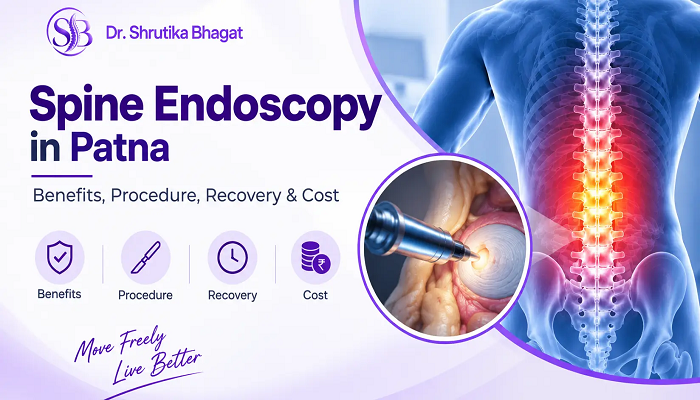
Spine endoscopy in Patnais a minimally invasive treatment approach used for selected spinal conditions, including certain cases of disc herniation, sciatica, spinal stenosis and nerve compression. Unlike conventional open procedures, endoscopic techniques use a small access channel and specialised camera systems to reach the affected area.
Dr. Shrutika Bhagat is an Interventional Pain Physician and Spine Endoscopy Specialist in Patna. Her clinical profile includes MBBS, MD, FIRA and FIAPM, along with specialised training in endoscopic spine procedures. Her website describes spine endoscopy as a keyhole approach for appropriately selected patients with spinal nerve compression and related conditions.
Visit the Dr. Shrutika Bhagat Home page to learn more about pain medicine and spine care in Patna.

What Is Spine Endoscopy?
Spine endoscopy is a minimally invasive technique in which a small endoscope and specialised instruments are used to access a targeted area of the spine. The camera provides magnified visualisation of the relevant anatomical structures while the physician performs the planned procedure through a small working channel.
The technique may be considered for selected spinal conditions when symptoms, clinical examination and imaging findings indicate that an endoscopic approach may be appropriate. It is not a suitable treatment for every patient with back pain or every type of disc problem.
The current Spine Endoscopy page on Dr. Shrutika Bhagat's website describes endoscopic treatment for selected conditions including lumbar disc herniation, spinal stenosis, cervical disc-related nerve compression, recurrent disc prolapse and some cases of failed back surgery syndrome.
Explore spine and pain conditions to understand the conditions evaluated as part of pain and spine care.
Who May Be a Candidate for Spine Endoscopy?
Spine endoscopy is generally considered only after an appropriate clinical assessment. A patient may be evaluated for endoscopic treatment when symptoms suggest nerve compression or another spinal problem that can potentially be addressed through a minimally invasive approach.
Depending on the diagnosis, conditions that may be evaluated include:
- Lumbar disc herniation
- Sciatica caused by nerve compression
- Lumbar canal or foraminal stenosis
- Cervical disc herniation with radicular symptoms
- Recurrent disc prolapse after previous surgery
- Selected cases of persistent pain after spine surgery
A diagnosis alone does not automatically make a patient suitable for spine endoscopy. Symptoms, neurological examination, MRI findings and the exact location and nature of the spinal problem need to be considered before selecting a treatment.

Benefits of Spine Endoscopy
For appropriately selected patients, minimally invasive spine endoscopy may offer several potential advantages compared with some conventional open procedures. The actual benefits vary according to the patient's condition and the procedure performed.
- Small access point compared with many conventional open approaches
- Reduced disruption of surrounding tissues in appropriately selected procedures
- Direct endoscopic visualisation of the targeted area
- Potentially shorter hospital or recovery time for selected patients
- Targeted treatment of certain disc and nerve compression problems
- May allow earlier mobilisation in appropriately selected cases
It is important not to assume that minimally invasive automatically means risk-free or appropriate for everyone. Spine endoscopy still requires careful patient selection, appropriate imaging, procedural expertise and discussion of potential risks and alternatives.
How Is Spine Endoscopy Performed?
The exact technique varies according to the spinal condition and the endoscopic approach selected. A typical treatment pathway may involve several stages.
1. Clinical Evaluation and MRI Review
The first step is to understand the patient's symptoms and correlate them with physical examination and relevant imaging. MRI can help identify disc herniation, nerve compression, stenosis or other structural abnormalities when clinically indicated.
2. Treatment Planning
The physician determines whether an endoscopic approach is appropriate and selects the most suitable access route based on the location of the pathology and the patient's anatomy.
3. Anaesthesia and Image Guidance
The procedure may be performed using local anaesthesia with appropriate sedation or another anaesthetic approach depending on the patient and procedure. Image guidance can assist with accurate placement of the working channel.
4. Endoscopic Visualisation
A small working channel is positioned to provide access to the affected area. The endoscope provides magnified visualisation so the physician can identify the relevant structures and pathology.
5. Targeted Treatment
Specialised instruments can be introduced through the working channel to address the identified pathology. The exact treatment depends on the diagnosis and the procedure planned.
6. Post-Procedure Monitoring
After the procedure, the patient is monitored according to the clinical protocol. Recovery and discharge instructions depend on the procedure, medical condition and individual response.

Types of Spine Endoscopy Procedures
Different endoscopic approaches may be used depending on the location of the spinal problem. The current treatment information on Dr. Shrutika Bhagat's website includes several endoscopic approaches.
Transforaminal Endoscopic Discectomy
A transforaminal approach accesses the spine through the neural foramen and may be considered for selected lumbar disc problems.
Interlaminar Endoscopic Discectomy
An interlaminar approach uses the natural interlaminar space to access selected spinal pathology and may be useful for appropriately selected lower lumbar disc conditions.
Unilateral Biportal Endoscopy
Unilateral biportal endoscopy uses separate access points for the camera and working instruments. It may be considered for selected decompression procedures.
Posterior Cervical Discectomy
Posterior cervical endoscopic procedures may be considered for selected cervical disc conditions causing nerve-related symptoms.
View all treatments and procedures available through Dr. Shrutika Bhagat's practice.
Spine Endoscopy Recovery Time
Spine endoscopy recovery time varies from patient to patient. Factors such as the spinal condition, procedure performed, neurological symptoms, overall health and physical demands of the patient's work can affect recovery.
The dedicated Spine Endoscopy page on the website states that appropriately selected patients may walk on the same day and may return to sedentary or light work within a few days. However, these are not guarantees for every patient, and the actual recovery timeline should be determined by the treating specialist.
Patients should follow their individual post-procedure instructions regarding activity, wound care, medication, driving, exercise and follow-up appointments.
When Can You Return to Work After Spine Endoscopy?
The time required to return to work depends on the procedure and the nature of the patient's occupation. Someone performing desk-based work may be able to resume light duties sooner than someone whose job requires heavy lifting, prolonged standing or strenuous physical activity.
The current clinic information reports that some patients may resume sedentary desk work and light computer activities within 3 to 7 days, while driving may require a longer period and post-procedure review.
Your treating physician should provide personalised instructions rather than relying on a standard recovery timeline.
Spine Endoscopy Cost in Patna
One of the most common questions patients ask is about the spine endoscopy cost in Patna. There is no single price that applies to every patient because the total treatment cost depends on several factors.
The final cost may vary according to:
- The spinal condition being treated
- The type of endoscopic procedure required
- Pre-procedure consultation and investigations
- MRI or other diagnostic imaging when required
- Hospital or procedure-facility charges
- Anaesthesia or sedation requirements
- Medications and post-procedure care
- Individual clinical and procedural requirements
For this reason, patients should be cautious about websites advertising a single fixed price for every spine endoscopy case. A personalised estimate is more appropriate after the diagnosis and required procedure have been established.
Contact Dr. Shrutika Bhagat for consultation and information about treatment planning and applicable costs.
Spine Endoscopy vs Open Spine Surgery
Spine endoscopy and conventional open spine surgery are different approaches. Endoscopic procedures use specialised instruments and a camera through a small access route, while traditional open procedures may require a larger surgical exposure depending on the operation.
Neither approach is automatically better for every patient. The correct choice depends on the underlying condition, anatomy, symptoms, neurological findings, imaging and the expected benefits and risks of each treatment option.
| Factor | Spine Endoscopy | Conventional Open Surgery |
|---|---|---|
| Access | Small minimally invasive access route | Usually larger surgical exposure |
| Visualisation | Endoscopic camera visualisation | Direct surgical exposure |
| Tissue disruption | Designed to minimise tissue disruption | May involve greater tissue exposure depending on procedure |
| Recovery | Can be shorter for selected procedures and patients | Varies according to the surgery performed |
| Suitability | Only for appropriately selected conditions | Required for conditions that cannot be adequately treated endoscopically |
Is Spine Endoscopy Safe?
Spine endoscopy is a minimally invasive procedure, but no medical procedure is completely free of risk. Potential complications depend on the procedure, spinal level, patient's health and other clinical factors.
Before treatment, patients should discuss potential complications, expected benefits, alternative treatments and recovery expectations with their specialist. Proper patient selection and appropriate procedural planning are important parts of safe spine care.
Why Choose a Spine Endoscopy Specialist in Patna?
When considering endoscopic spine treatment, patients should look beyond marketing terms and assess the doctor's relevant qualifications, specialist training, experience, diagnostic approach and ability to explain treatment alternatives.
Dr. Shrutika Bhagat's professional profile identifies her as an Interventional Pain Physician and Spine Endoscopy Specialist. Her listed qualifications include MBBS, MD, FIRA and FIAPM, along with fellowship training in endoscopic spine procedures.
Read Dr. Shrutika Bhagat's professional profile to learn more about her medical education, fellowship training and areas of clinical interest.
Spine Endoscopy and Pain Medicine in India
Endoscopic spine procedures are increasingly discussed within modern Pain Medicine and minimally invasive spine care in India. The Indian Society for Study of Pain (ISSP) describes Minimally Invasive Pain and Spine Interventions (MIPSI) as a broad group of diagnostic and therapeutic interventions that can include endoscopic techniques and image-guided procedures.
The ISSP also discusses endoscopic spine interventions as part of the evolving field of minimally invasive pain and spine care. Patients should use professional medical information as educational guidance and discuss their individual condition with a qualified specialist.
Book a Spine Consultation in Patna
If you have persistent back pain, sciatica, numbness, radiating leg pain or symptoms associated with a diagnosed disc problem, a specialist assessment can help determine whether conservative care, interventional treatment, spine endoscopy or another approach may be appropriate.
Dr. Shrutika Bhagat provides spine and pain consultations in Patna. The clinic's current contact information lists Dr. Shrutika's Spine & Pain Clinic, Popular Residency, 3A-Arya Kumar Road, Rajendra Nagar, Patna - 800016.
Book a consultation or contact the clinic for further information.
Home | About Doctor | Conditions | Treatments | Contact